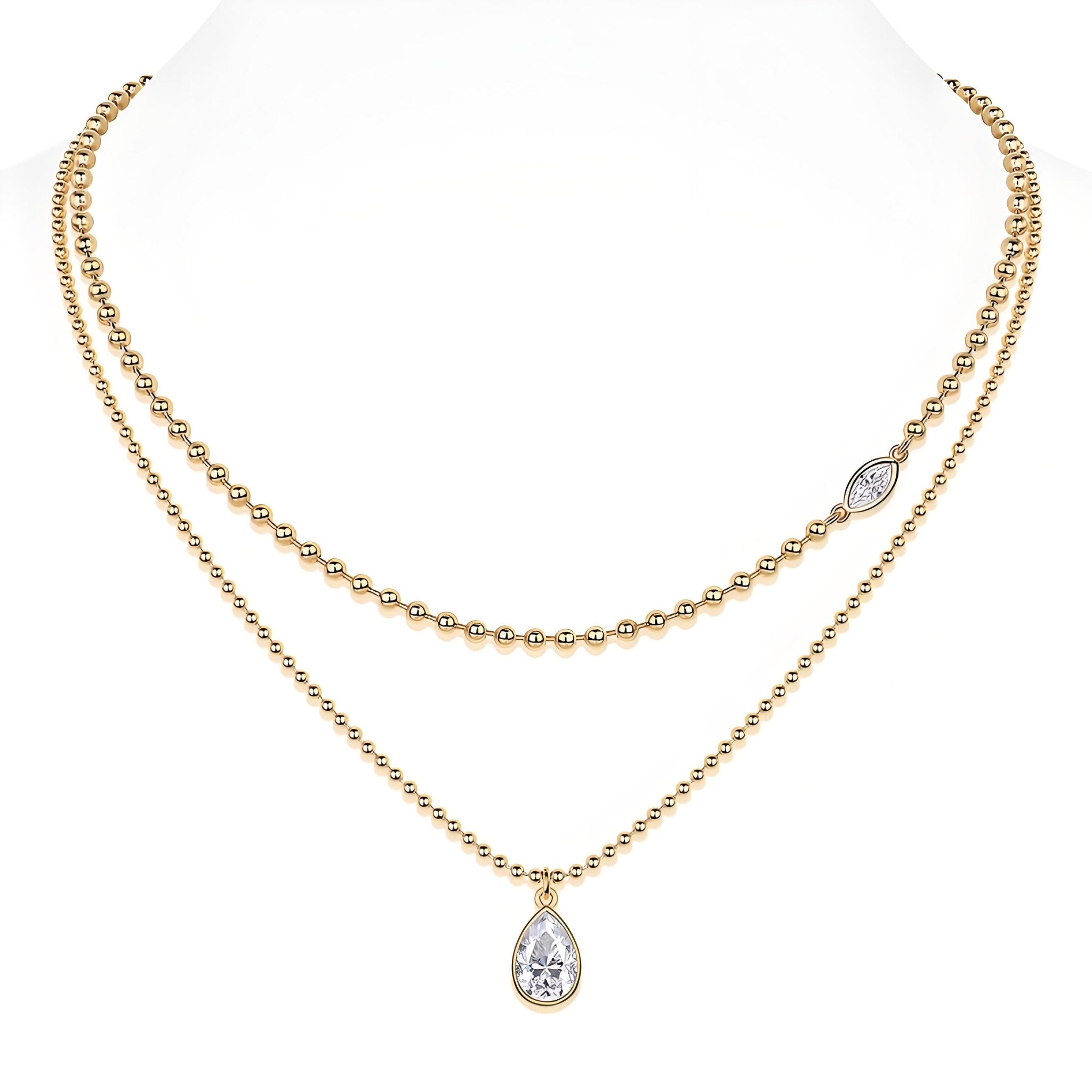

Let's talk about the shapes that make people stop mid-scroll. While half the world is buying round diamonds, a certain breed of bride—the one who's never met a trend she couldn't resist and then abandon—is quietly building Pinterest boards around emerald, marquise, and pear cuts. These aren't just diamonds. They're declarations.
The choice you make here? It's going to define every single "let me see the ring" moment for the rest of your life. No pressure.
The Emerald Cut: For the Woman Who Quotes Architectural Digest
If you've ever used the phrase "quiet luxury" unironically, the emerald cut is your destiny. This is the diamond equivalent of a perfectly cut blazer—architectural, impossibly elegant, utterly unforgiving of anything less than perfection.
Here's what nobody tells you: emerald cuts don't sparkle. They flash. With 57 step-cut facets arranged in parallel rows like a glamorous hall of mirrors, this cut prioritizes drama over twinkle. It's a window straight into the stone's soul, which sounds romantic until you realize it means every single inclusion is having its close-up.
The proportions matter viciously here. You want a length-to-width ratio between 1.30 and 1.50—with 1.40 being the Goldilocks number that says "I know exactly what I'm doing." Table percentages between 61% and 69%, depth from 60% to 68%. These aren't suggestions. They're the difference between Grace Kelly and trying too hard.
Now, let's discuss the financial plot twist everyone loves: emerald cuts cost 20-30% less per carat than rounds because they waste less rough diamond. At La Pretti, a spectacular 1.50-carat natural emerald will run you $8,500-$12,000. But here's where it gets interesting—lab-grown emeralds with identical optical properties (same refractive index, same everything except the mining backstory) come in at $3,400-$4,800. That's a 40-60% savings that could fund your honeymoon to Amalfi.
According to gemological research from GIA, lab-grown diamonds perform identically to natural stones in every measurable way. Which means the only difference is the story you tell at dinner parties.
This cut worships long, elegant fingers. But it demands—absolutely demands—VVS1 clarity or better. Anything less and you're wearing a magnified flaw chart.
The Marquise Cut: Maximum Drama, Minimum Apologies
The marquise cut has a origin story that's almost too good: commissioned by Louis XV to match the smile of his mistress, the Marquise de Pompadour. If that doesn't scream "main character energy," nothing does.
This football-shaped wonder delivers the most bang for your carat—literally 15% more surface area than a round diamond of the same weight. It's geometric sorcery, and it's spectacular.
Your ideal ratio lives between 1.75 and 2.25, with 2.00 being the classic "yes, I meant to go this bold" sweet spot. Depth should measure 58-62%, table from 53-63%. But here's the marquise's dirty little secret: the bow-tie effect. That dark shadow across the center where light escapes? It haunts poorly cut marquises like a bad wedding vendor review.
The good news: well-cut stones minimize this dramatically through precise pavilion angles. Research published in GIA's Gems & Gemology proves that properly proportioned marquises achieve light return within 5% of ideal rounds while looking significantly larger. That's not marketing speak—that's physics.
The pricing story gets even better. Natural marquises cost 25-35% less than rounds, putting a gorgeous 1.50-carat stone at $7,200-$10,500. Lab-grown? Try $2,900-$4,200 for identical brilliance. Same refractive index (2.417), same dispersion rate (0.044), same ability to make your friends quietly resent their own rings.
This cut transforms shorter fingers into supermodel proportions through sheer visual elongation. But those pointed ends are vulnerable—demand V-prong or bezel settings unless you enjoy expensive repair bills.
The Pear Cut: The Romantic Who Reads French Vogue
The pear shape is what happens when a round brilliant and a marquise have a love child raised on vintage champagne and Audrey Hepburn films. This teardrop silhouette hits that impossible sweet spot between feminine and fashion-forward.
Fifty-eight facets arranged in a configuration so complex it separates master cutters from amateurs. The length-to-width ratio sweet spot? 1.45 to 1.75, with 1.55 being universally worshipped for good reason. The rounded end should curve gently—never flat, never bulbous—while the point aligns with mathematical precision.
Here's the insider move: pear shapes are reversible. Point toward your fingertip for modern elongation, flip it backward for vintage romance. It's like having two rings, except you only had to say yes once.
The bow-tie effect lurks here too, but superior cutting reduces it to barely noticeable. And the pricing? Identical to emeralds—20-30% less than rounds. Natural pears at 1.50 carats run $8,000-$11,500, while lab-grown versions span $3,200-$4,600. International Gemological Institute testing confirms what gemologists already know: lab-grown diamonds across all fancy shapes share identical hardness (10 on Mohs scale), thermal conductivity, and optical performance with natural stones.
This shape flatters everyone but absolutely sings on slender fingers when worn point-out. It's universally flattering in the way a perfect little black dress is—effortlessly chic regardless of the wearer.
The Verdict You've Been Scrolling For
Choose your diamond like you'd choose your signature scent—based on what makes you feel impossibly yourself.
Emerald if your aesthetic involves monochromatic neutrals, museum memberships, and the phrase "less is more."
Marquise if you've never met a statement you couldn't make louder, vintage glamour runs through your veins, and you consider "too much" a starting point.
Pear if you want romantic femininity with an edge of unpredictability, and you appreciate jewelry that works as hard as you do with its orientation versatility.
But here's the non-negotiable: cut quality trumps everything. A brilliantly cut diamond with modest color and clarity will outperform a poorly proportioned stone with perfect stats every single time. It's not even close.
Work only with jewelers who provide complete certifications from GIA, AGS, or IGI. These aren't optional credentials—they're your insurance policy against expensive regret.
At La Pretti, we've spent generations guiding families who understand that true luxury isn't about the biggest or flashiest acquisition. It's about educated decisions that transcend trends and deliver enduring value—whether you choose natural or laboratory-grown stones that meet identical quality standards.
Your diamond should feel like the exclamation point on your love story, not a question mark about whether you chose correctly. Choose the shape that makes your heart beat faster when you catch it in unexpected reflections. That's the one.

